Free Contractor Matching Epoxy, Polyaspartic, Urethane Cement & Polished Businesses Across Ottawa
Get Floor Quotes

Part of the Ottawa Construction Network

Commercial Floor Coating Quotes for Ottawa Businesses

Epoxy, polyaspartic, urethane cement and polished concrete for kitchens, warehouses, shops, labs and common areas. Tell us about the floor and local contractors reply by email.

Fields marked are required. No phone number needed — your matches reply by email.

Free matching. We do not inspect, license or screen the contractors we forward requests to: ask for the WSIB clearance and the product data sheets yourself.

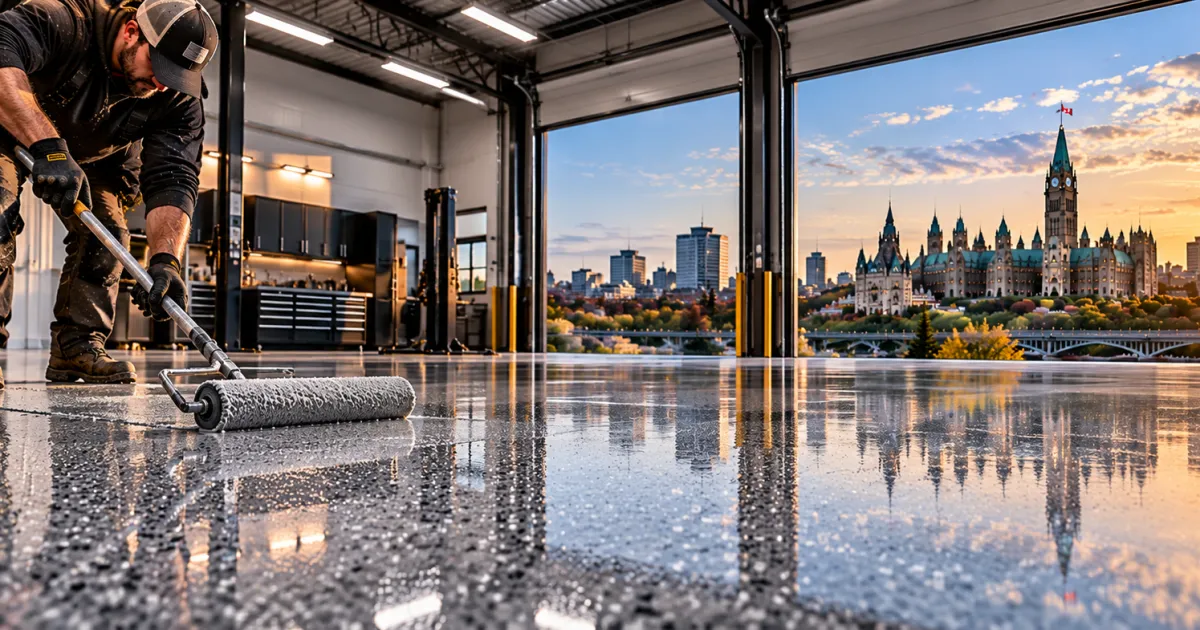
Worker rolling a flake-broadcast epoxy floor in an open-bay shop, the glossy floor reflecting Parliament Hill through the open doors

How a Commercial Floor System Is Built

The coating is the last layer of five. What happens to the slab first decides whether the rest stays bonded.

What sits under a commercial floor coating Five layers from the top: 5 Topcoat, 4 Body coat or broadcast, 3 Primer, 2 Prepared surface, 1 Concrete slab. Not to scale. 5. Topcoat: The wearing surface, chosen for the traffic and the cleaning. Anti-slip aggregate such as aluminium oxide or quartz can be broadcast into it. 5 Topcoat 4. Body coat or broadcast: The build of the system: a body coat, a self-levelling or trowelled layer, or a coat with sand or coloured flake broadcast into it. 4 Body coat or broadcast 3. Primer: Bonds the system to the slab. A moisture-tolerant primer is an extra line item when the slab tests wet. 3 Primer 2. Prepared surface: The slab is ground or shot-blasted to the surface profile the product asks for (data sheets we read ask for about CSP 2 to CSP 5 on the ICRI scale), with cracks and joints repaired. 2 Prepared surface 1. Concrete slab: Tested for moisture first: ASTM F2170 measures relative humidity inside the slab with in-situ probes. One epoxy data sheet also asks for at least 28 days of curing on new concrete. 1 Concrete slab
  1. Topcoat. The wearing surface, chosen for the traffic and the cleaning. Anti-slip aggregate such as aluminium oxide or quartz can be broadcast into it.
  2. Body coat or broadcast. The build of the system: a body coat, a self-levelling or trowelled layer, or a coat with sand or coloured flake broadcast into it.
  3. Primer. Bonds the system to the slab. A moisture-tolerant primer is an extra line item when the slab tests wet.
  4. Prepared surface. The slab is ground or shot-blasted to the surface profile the product asks for (data sheets we read ask for about CSP 2 to CSP 5 on the ICRI scale), with cracks and joints repaired.
  5. Concrete slab. Tested for moisture first: ASTM F2170 measures relative humidity inside the slab with in-situ probes. One epoxy data sheet also asks for at least 28 days of curing on new concrete.
Schematic, not to scale, with no thicknesses: those come from the product's data sheet. Polished concrete skips layers 3 to 5: the slab itself is ground, densified and polished.
Choosing a system: what the data sheets say
SystemBack in serviceCold rooms and cold slabsHot washdown and thermal shockDamp slabs
Epoxy One data sheet: foot traffic 24 h; light vehicles 72 h; heavy traffic 7 daysOne data sheet: not applied below 10 °COne coatings maker's article says it does not perform as well as other materials under thermal shockData sheets we read: slab at or below about 75 to 80% RH
Polyaspartic One data sheet: light traffic 24 h; vehicles 7 daysOne data sheet: minimum surface about 4 °CNo source foundOne data sheet: slab at or below 80% RH
Urethane cement One data sheet: light foot traffic 18 h; heavy traffic and chemicals 72 hOne installer gives an operating range of about -40 to 120 °CRecommended for commercial kitchens in the same maker's articleOne data sheet: up to 99% RH on a self-levelling product
MMA One brochure (2010): cures in about one hourSame brochure: cures down to about -29 °CNo source foundNo source found
Polished concrete No coating to cure; we found no source for a return-to-service timeNo coating is appliedNo coating is appliedNo coating is applied

Typical figures from one manufacturer's data sheet per cell (US-market documents read September 2026); your product's data sheet governs. A blank means we found no source.

How Long Will You Be Closed?

Cure times come from the product's data sheet, not from a rule. Here is what the data sheets we read say, and a planner that sends the system you are weighing straight to the request form.

From first foot traffic to full service, per one data sheet each Urethane cement: 18 h light foot traffic to 72 h heavy traffic. Epoxy: 24 h foot traffic to 7 days heavy traffic. Polyaspartic: 24 h light traffic to 7 days vehicles. Urethane cement: 18 h light foot traffic to 72 h heavy traffic (one self-levelling urethane cement guide spec) Urethane cement 18 h light foot traffic to 72 h heavy traffic Epoxy: 24 h foot traffic to 7 days heavy traffic (one 100%-solids epoxy data sheet) Epoxy 24 h foot traffic to 7 days heavy traffic Polyaspartic: 24 h light traffic to 7 days vehicles (one polyaspartic data sheet) Polyaspartic 24 h light traffic to 7 days vehicles 02 days4 days7 days
Show the numbers as a table
From first foot traffic to full service, per one data sheet each
SystemFirst traffic (hours)Full service (hours)Source
Urethane cement1872one self-levelling urethane cement guide spec
Epoxy24168one 100%-solids epoxy data sheet
Polyaspartic24168one polyaspartic data sheet
Sources, one per bar: Urethane cement, one self-levelling urethane cement guide spec; Epoxy, one 100%-solids epoxy data sheet; Polyaspartic, one polyaspartic data sheet. The ring on the epoxy bar marks light vehicles 72 h. MMA (one 2010 brochure says about one hour) and polished concrete (no coating to cure, no source) are not charted. At about 21 to 25 °C. Prep, crack repair and moisture-test days come on top. The data sheet for the product in your quote sets the actual times.
1. Which system are you considering?

The size goes to the contractors with your request. We found no published source that turns floor size into days, so it does not change the figures.

Epoxy

First traffic
per one epoxy data sheet, foot traffic after about 24 h
Full service
per the same data sheet, light vehicles after about 72 h and heavy traffic after about 7 days

Source: one 100%-solids epoxy data sheet. Moisture-test and prep days are not included. The product data sheet sets the actual time, and the room temperature changes it.

Get quotes for this

Polyaspartic or polyurea

First traffic
per one polyaspartic data sheet, light traffic after about 24 h (dry to touch in 2 to 4 h)
Full service
per the same data sheet, vehicles after about 7 days

Source: one polyaspartic data sheet. Moisture-test and prep days are not included. The product data sheet sets the actual time, and the room temperature changes it.

Get quotes for this

Urethane cement

First traffic
per one urethane cement guide spec, light foot traffic after about 18 h
Full service
per the same guide spec, heavy traffic, moisture and chemicals after about 72 h

Source: one self-levelling urethane cement guide spec. Moisture-test and prep days are not included. The product data sheet sets the actual time, and the room temperature changes it.

Get quotes for this

MMA

First traffic
per one MMA brochure from 2010, cured in about one hour
Full service
ask for the current data sheet; we found no full-service figure

Source: one MMA brochure from 2010. Moisture-test and prep days are not included. The product data sheet sets the actual time, and the room temperature changes it.

Get quotes for this

Polished concrete

First traffic
no coating to cure
Full service
we found no source for a return-to-service time; ask how many grinding passes are planned and whether part of the floor can stay open

Source: no data sheet applies. Moisture-test and prep days are not included. The product data sheet sets the actual time, and the room temperature changes it.

Get quotes for this

What Ontario's Rules Say About the Floor

Food premises

O. Reg. 493/17 asks for floors in food rooms that are "tight, smooth and non-absorbent" and kept clean and in good repair. It names no product and does not mention coving, drains or slope. Ottawa Public Health inspects.

Kitchen and food plant floors

Slippery finishes

Reg. 851, s.11: a floor used by workers must not have a finish "likely to make the surface slippery". No slip-resistance number is set in Ontario law, so a test value in a quote is a product claim.

Anti-slip finishes and safety lines

Before grinding

OHSA s.30: before a project starts, the owner lists designated substances (asbestos, silica, isocyanates) and gives the list to contractors before signing. Have old tile and mastic tested first.

Grinding, prep and moisture testing

VOC limits

Federal rules (SOR/2009-264) cap opaque floor coatings at 250 g/L. They bind the companies that make, import or sell the product, not the contractor applying it.

More questions

Frequently Asked Questions

How much does a commercial epoxy floor cost in Ottawa?

Published 2025-2026 Ontario and Canadian contractor ranges put commercial and industrial-grade epoxy at about $8 to $15 per square foot installed, with lighter commercial systems from about $5. Slab prep, crack repair, a moisture-mitigation primer, cove base and after-hours work all move the price. These are published ranges, not rates, so compare at least two written quotes line by line.

What does Ontario require of a restaurant kitchen floor?

Ontario's Food Premises regulation (O. Reg. 493/17, s.7(1)(c)) requires floors in rooms where food is prepared, served or handled, and where utensils are washed, to be "tight, smooth and non-absorbent", and s.7(1)(g) requires them to be kept clean and in good repair. The regulation does not name a product and does not mention coved bases, floor drains or slope. Ottawa Public Health inspects food premises and asks to be told about significant renovations.

How long will my business have to close for a new floor?

It depends on the product's data sheet, the slab and the room temperature. Typical figures from the data sheets we read: an epoxy at 24 hours for foot traffic and up to 7 days for heavy traffic, a self-levelling urethane cement at 18 hours for light foot traffic and 72 hours for heavy traffic, and a polyaspartic at 24 hours for light traffic and 7 days for vehicles. Prep and moisture-test days come on top. The data sheet for your product governs.

Does my business need a WSIB clearance from the contractor?

Yes. WSIB policy says a business that hires a contractor for construction work must get a clearance certificate before the work begins and keep it in effect while the work goes on. Without it, the business may be liable for the contractor's WSIB payment obligations up to the value of the labour portion of the contract. The homeowner exemption does not apply to businesses.

Get Floor Quotes